Mandatory CMMI models built around drug prices, including the newly finalized GLOBE Model, face a perennial structural tension: the design choices that would generate meaningful Medicare savings are the same ones most likely to erode patient access and future innovation.
The Center for Medicare and Medicaid Innovation (CMMI) was created to test new ways of paying for and delivering care. However, over the years it has frequently been used to attempt to test something different: administratively set drug prices.
On October 2, 2026, CMS finalized the Global Benchmark for Efficient Drug Pricing (GLOBE) Model, a mandatory Medicare Part B model that requires manufacturers to pay rebates when Part B payment exceeds an international benchmark. A Part D companion model, the Guarding U.S. Medicare Against Rising Drug Costs (GUARD) Model, is pending.
A month after GLOBE was finalized, many healthcare stakeholders remain divided about how to interpret the model’s long-term impact. On one hand, the rare disease community secured critical wins, including exemptions for orphan products and other complex therapies. Many manufacturers expect waivers from GLOBE by agreeing to Medicaid price concessions through the GENEROUS Model. On the other hand, GLOBE is now part of federal regulations. Absent litigation that invalidates it, the model will have a longevity that may outlive both the current drug pricing deals and the current administration, setting a dangerous policy precedent.
CMMI Was Built to Test Care Delivery, Not to Set Prices
The Affordable Care Act established CMMI to “test innovative payment and service delivery models” that reduce spending while preserving or improving quality. The statute gave CMMI unusual latitude: it can waive various Medicare statutory requirements, launch a wide range of pilot programs, and expand successful models nationally if they generate savings without harming quality of care or patient outcomes.
That latitude was designed for a specific purpose. Models were meant to test holistic changes to how care is paid for and organized that align incentives across payers, providers, and patients in ways too complex for Congress to enact through individual policy changes. The underlying theory is behavioral: realign those incentives, observe how stakeholders respond, monitor for unintended consequences and scale what works.
Drug pricing models do not fit neatly into that framework. When a model’s primary lever is the price paid for a product, the behavior being “tested” is largely a manufacturer’s willingness to accept a lower price. That looks less like a care delivery experiment and more like rate setting, which is why the industry’s legal challenge to GLOBE argues the model is not a legitimate “test” under Section 1115A.
The framework also depends on CMMI’s ability to monitor for unintended consequences, and drug pricing is where that ability is weakest. The outcomes of changing drug prices are complex and play out over years. CMMI can track near-term changes in utilization and prescribing, but it lacks the funding, authority, and expertise to measure long-term impacts on R&D, investment patterns and shifts in pipeline priorities. Many of these effects, such as a deprioritized indication, a delayed launch or an early-stage program that never advances, will not show up in an annual CMMI evaluation report. Yet they ultimately carry far more significant consequences for patient access to and availability of treatments than the metrics CMMI is built to evaluate.
Mandatory CMMI Pricing Models Distort the Incentives They Are Meant to Realign
Successive administrations have turned to CMMI to pursue drug pricing goals that Congress has not enacted. The 2016 Part B Drug Payment Model proposal, the 2018 International Pricing Index proposal and the 2020 Most Favored Nation interim final rule all sought to lower Part B drug payment through CMMI authority. None was implemented, in part because of legal and stakeholder pushback. GLOBE is the first mandatory international reference pricing model to be finalized.
A defining feature of all these models is that drugs are selected by spending. GLOBE applies to single-source Part B drugs and biologicals in seven therapeutic classes with more than $100 million in annual Part B fee-for-service spending. Once a drug crosses that threshold, it stays in the model for the rest of the five-year performance period.
But spending-based selection creates distortions:
- It targets success, not inefficiency. Spending is driven by both price and volume and high-spend Part B drugs are often those that physicians use most because they work well.
- It says nothing about value. A spending threshold does not distinguish a high-value therapy from a low-value one. It only identifies which products have achieved broad uptake.
- It changes the incentive to grow. If uptake past a threshold triggers mandatory price reductions, manufacturers face a penalty for expanding use, including into new indications that could benefit patients.
- It compounds other policies. The Inflation Reduction Act’s negotiation program already selects drugs by spending. Layering a second spending-triggered price control earlier in the lifecycle concentrates even more pressure on the most successful products.
Why GLOBE Cannot Succeed as Designed
Under existing law, a model succeeds only if it reduces spending without harming quality and outcomes. GLOBE’s two goals pull against each other: the larger the savings, the greater the risk to access and innovation. Every version of the model lands on one side of that trade-off.
Figure 1: GLOBE’s savings goal and quality goal pull in opposite directions:
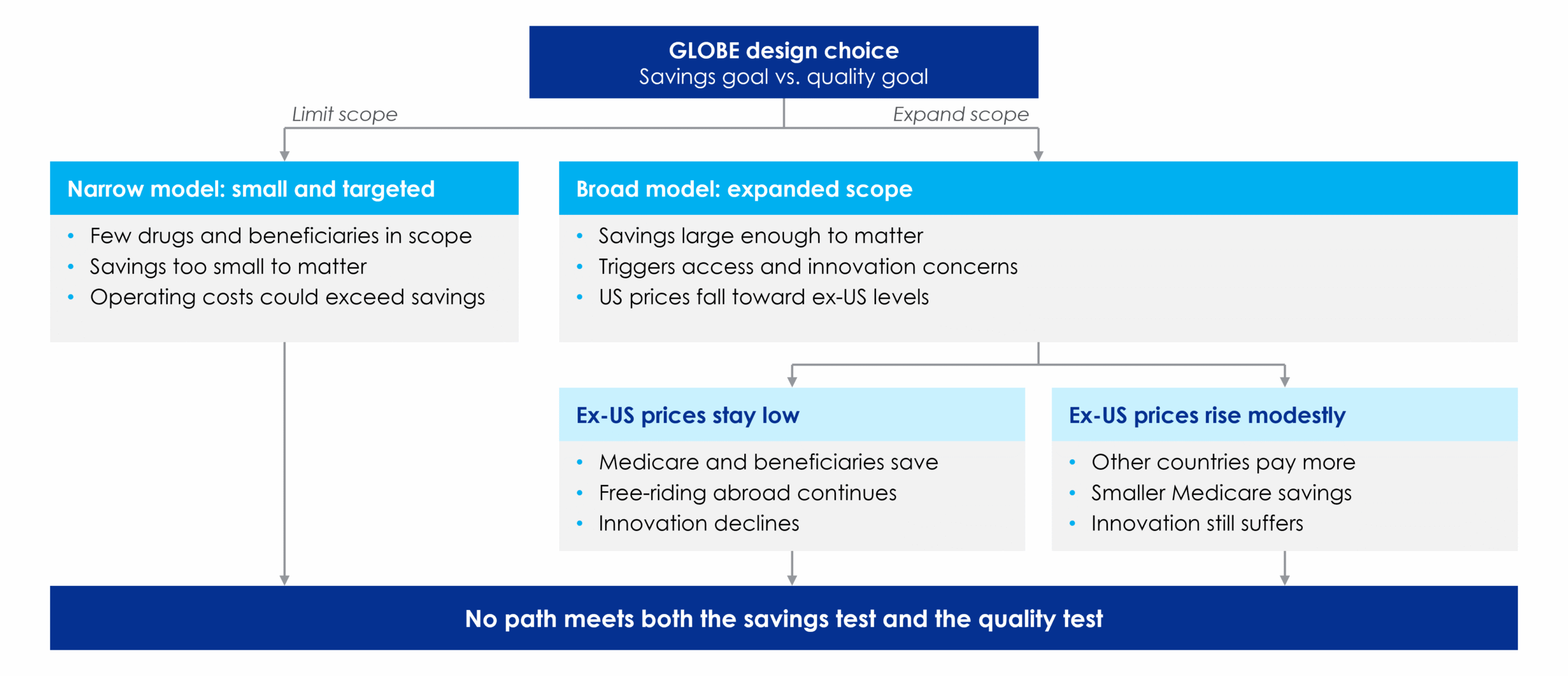
A narrow model saves too little to matter. The final rule shows this path. CMS limited GLOBE to seven drug classes, a $100 million spending threshold and randomly selected areas covering about 25% of eligible Part B beneficiaries. It excluded orphan-only drugs, cell and gene therapies, plasma-derived products, and drugs with a negotiated maximum fair price, and it waives manufacturers that join GENEROUS. As a result, CMS’s estimate of annualized net savings fell from about $2.3 billion in the proposed rule to about $80 million in the final rule. At that scale, the cost of running the model, including benchmark calculation, quarterly invoicing, reconciliation, evaluation and manufacturer compliance, could rival or exceed the savings. The narrow model limits harm to access and innovation, but it also limits the case for the model itself.
A broad model triggers significant access and innovation concerns. Expanding to more drugs or more beneficiaries would generate savings large enough to matter, but also elicit additional cascading dynamics and would push US prices for widely used Part B drugs that treat vulnerable beneficiaries with complex conditions. A pricing shift like this in the US would reduce the revenue that funds research and development for new indications and next-generation therapies. It could also delay or narrow patient access for existing products.
The effects would also extend well beyond Medicare. The life sciences sector supports a vast network of research institutions, contract manufacturers, suppliers, and high-wage jobs. Sustained revenue losses would ripple through that ecosystem, slowing investment in early-stage biotech and weakening one of the most critical US industries. Yet CMMI is narrowly built to evaluate direct Medicare savings. The broader federal budget effects of lower manufacturer revenues, including reduced tax receipts and diminished economic activity, fall outside what CMMI is designed to measure, meaning a model could appear to save money for Medicare while costing the federal government more overall.
CMMI’s theory is that GLOBE will create incentives for manufacturers to raise ex-US prices, producing more global price parity and protecting innovation and manufacturer revenues over the long term. This position is overly optimistic, because the Innovation Center sets ex-US prices as the benchmark, yet the US government has limited ability to influence ex-US pricing policy. Recent US trade pressure on European governments, including a Section 301 investigation into Germany’s drug pricing, shows the administration recognizes this limitation, but those efforts remain early and their outcome is uncertain.
From there, two paths are possible:
- Ex-US prices stay low. Medicare and beneficiaries save, but other countries keep paying less, so free-riding on US-funded innovation continues. The US simply absorbs a lower return, and investment in new therapies declines.
- Ex-US prices rise modestly. Other countries pay somewhat more, which narrows the benchmark gap and shrinks Medicare’s savings. Innovation still suffers because modest increases abroad cannot replace the revenue lost in the US.
Looking Ahead
Drug pricing is a key priority for policymakers and patients. But mandatory CMMI models are the wrong tool: they impose arbitrary government price cuts that penalize the most successful products, substitute administrative price setting for genuine testing, distort the market signals that reward clinical value, artificially change the investment calculus that underlies future innovation, and face a design trade-off they cannot escape. In short, the model is either too small to save money or large enough to impose the very access and innovation costs that would fail the quality test for expansion. And whichever path CMS takes, the largest costs, from slower R&D investment and fewer new therapies to lost jobs and reduced economic activity across the life sciences ecosystem, fall entirely outside what CMMI is built to measure.