For decades, the United States has been the undisputed global center of biopharmaceutical innovation. That position was the product of deliberate policy choices around regulatory and tax incentives, favorable market conditions, a strong research ecosystem, and capital markets eager to fund early-stage science. Companies had every reason to run their trials and seek approval in the US first, so American patients got access to innovation first too.
That lead, however, can no longer be taken for granted. Domestic headwinds, such as rising trial costs, regulatory unpredictability, and drug pricing uncertainty, are putting new pressures on the US life science sector at a time when other countries have made biotech a national priority.
The upcoming Prescription Drug User Fee Act (PDUFA) reauthorization process, novel regulatory pilots, and leadership changes at the FDA are all prompting new conversations about how to modernize and expedite drug development. Together, they create a timely opening for stakeholders to reduce barriers to patient access for innovative medicines and keep the US competitive in biotech innovation.
Countries like Australia, South Korea and China have deployed various R&D incentives and are experiencing significant growth in clinical trials, while other countries are exploring cross-border efforts to expand regulatory harmonization. For rare disease specifically, foreign regulators are increasingly building purpose-designed approval frameworks, while in the US, sponsors continue to face uncertainty in how evidentiary standards are applied to rare and ultra-rare populations despite recent advances and pilots. The US remains the first market for the majority of new medicines, but these shifts warrant monitoring — particularly in therapy areas where purpose-built foreign pathways now offer sponsors a faster route to a first approval.
Majority of Novel Drugs Continue to Gain First Approval in the US, Ahead of Other Markets
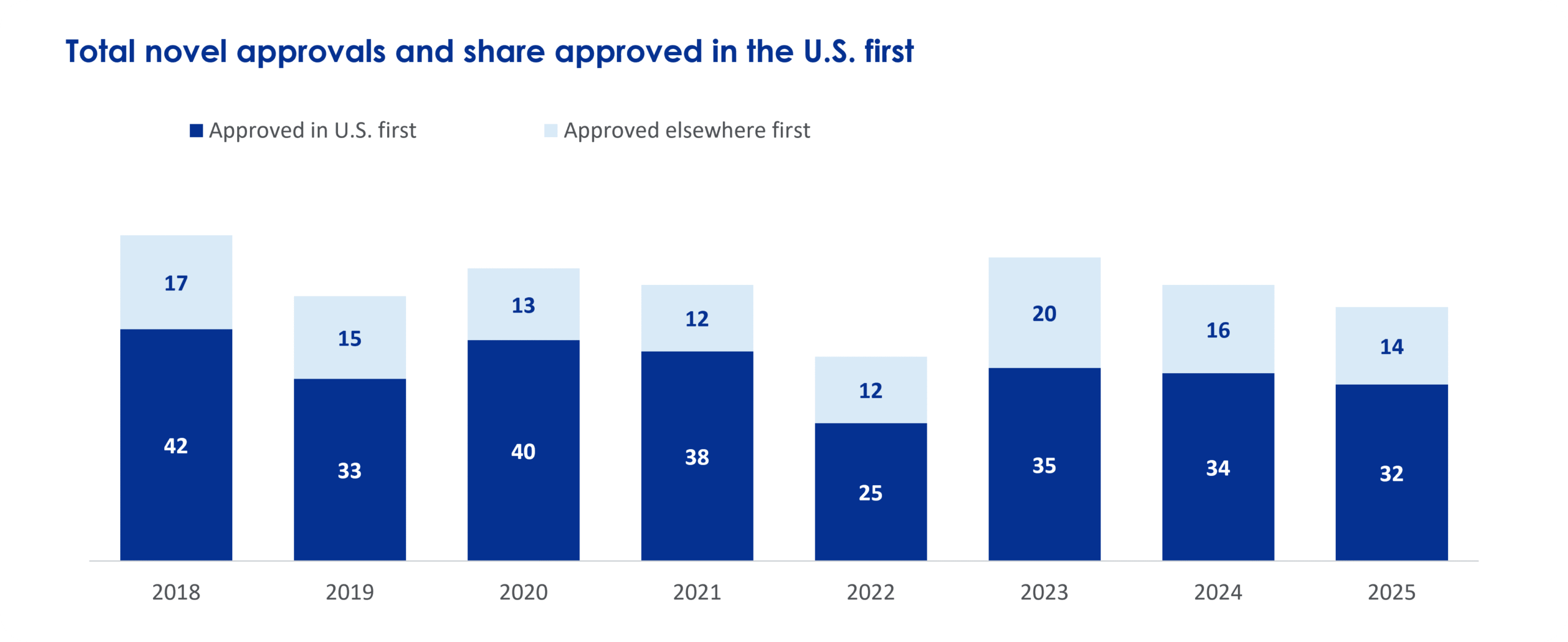
According to FDA’s annual reports on novel drug approvals, 398 novel drugs were approved in the US between 2018 and 2025. On average, about 70% of them reached the US market before any other, with a range of 63.6% (2023) to 76.0% (2021) (see Figure 1). Approval dates throughout this analysis reflect the first marketing authorization granted by each regulator, drawn from FDA’s annual novel drug approval reports and the corresponding ex-US regulator records.
Of the 119 drugs approved outside the US first between 2018 and 2025, 94 (79%) were authorized in another advanced market — the EU, UK, Canada, or Japan. But European first approvals fell from 34 drugs in 2018–2021 to 25 in 2022–2025, while Canada and Japan held steady across the two periods, at 4 and 15 drugs respectively. First approvals in South Korea and China rose from 0 to 12, driven mainly by China (9 products, 8 of which focused on oncology).
Figure 1: Novel drugs approved by ex-US bodies first vs. US first (Source: Blue Matter Analysis)
Rare Disease Products Make Up Roughly Half of Drugs Approved Elsewhere First
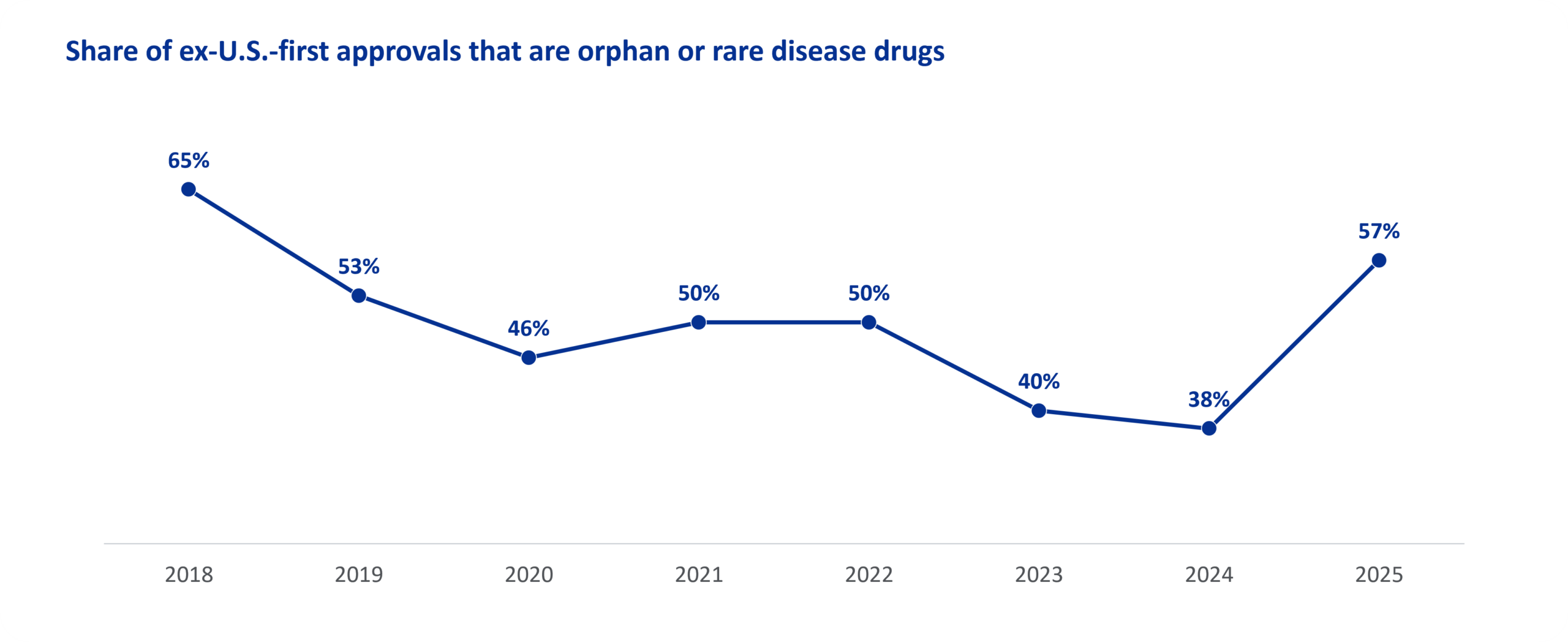
Notably, among the remaining 30% approved in another market first, roughly half carried orphan designations. That amounts to 59 rare disease products between 2018 and 2025 that reach patients abroad before they reach patients here, even with Orphan Drug Act incentives in place to encourage investment in rare and ultra-rare conditions (see Figure 2).
Figure 2: Percent of ex-US-first approvals that are rare/orphan (Source: Blue Matter Analysis)
Where the US Is Not First, the Typical Gap Is Roughly Ten Months and Far Longer in Outlier Cases
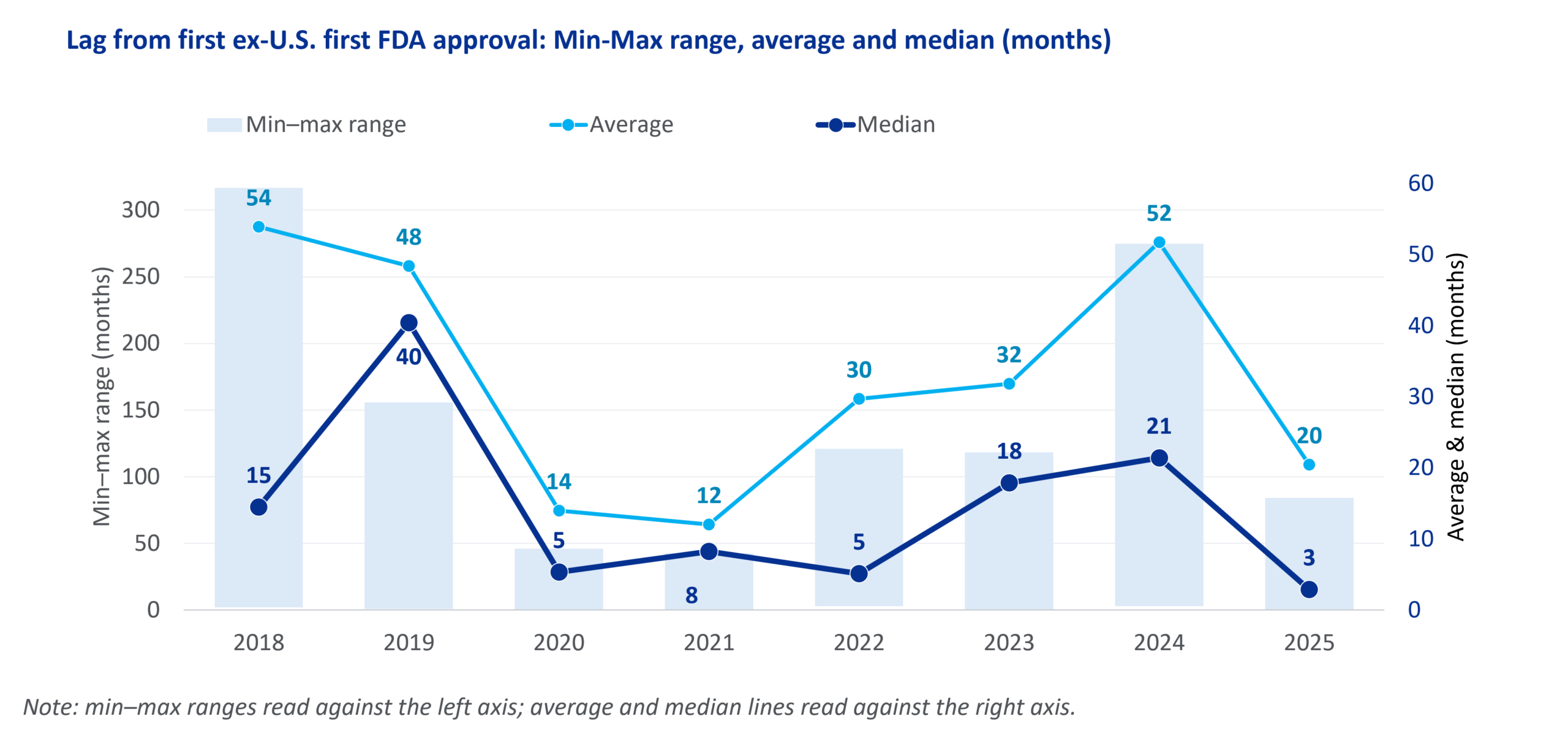
For the 94 drugs first approved in another advanced market, Blue Matter also analyzed the lag before US authorization. Across these products, the time lapse between the first approval abroad and the subsequent US FDA authorization averaged 35.8 months from 2018 to 2025, with a median of 10.3 months (see Figure 3). The medicines first approved in other advanced markets include products for diseases like acquired thrombotic thrombocytopenic purpura, which is acutely fatal if untreated, and fatal progressive genetic conditions like Dravet syndrome, Fabry disease, and late-onset Pompe disease. For this subset of life-saving medications, the median lag between ex-US and US approvals was 20.2 months.
Figure 3: Lag between first approval in other advanced markets (EU, UK, Canada, or Japan) and subsequent US approval (Source: Blue Matter Analysis)
Looking Ahead
A variety of factors shape where innovation, research, clinical trials, and ultimately approvals occur first: the time and cost of activating US trial sites, duplicative or unpredictable requirements across – or even within – regulators, sponsor filing and commercialization sequencing, reimbursement and pricing expectations, and access to capital for small and emerging companies. This analysis measures timing and does not attribute any individual gap to a single cause. But the results signal that for some innovative therapies—particularly in rare disease, where few alternatives may exist—US patients may wait months, or in some cases years, for treatments already available in other advanced markets. As various other policy pressures stemming from the Inflation Reduction Act (IRA) and Most Favored Nation (MFN) are further complicating manufacturers’ development and launch sequencing decisions, it is critical to focus on timely access to innovation as the strategic imperative for policymakers.
The remedy is straightforward in principle: keep the incentives for US-first launch strong and take avoidable regulatory friction out of the path. As part of ongoing efforts to maintain US life science leadership, stakeholders should work to identify practical solutions for closing these gaps and preserving incentives for US-first launches. That effort should include sustained engagement with emerging biotechs, which conduct much of the earliest and highest-risk research and represent a significant engine of breakthrough innovation, high-wage employment, and domestic economic activity. Policymakers and industry should understand where the pain points persist and where additional policy focus is warranted.
Methodology
To conduct this analysis, Blue Matter reviewed eight years of FDA novel drug approval annual reports (2018 to 2025). For each of the 398 novel drugs approved by the FDA over that period, we determined which products treat rare conditions and whether the US or another regulator granted the first marketing authorization. In instances where a drug had been approved outside the US first, we identified the geography and confirmed the approval date through the corresponding regulator’s approval records. The time-lag analysis focuses on the subset of products first approved by other advanced markets defined as the EU (EMA), UK (MHRA), Canada (Health Canada), and Japan (MHLW) and measures the interval between the first advanced market approval and subsequent FDA authorization.