
Under the Inflation Reduction Act’s (IRA’s) Medicare Drug Price Negotiation Program, the Centers for Medicare & Medicaid Services (CMS) must consider the research and development (R&D) costs of a selected drug and the extent to which the manufacturer has recouped them in the price-setting process. The difficulty is that the per-asset, lifetime R&D cost figure that CMS requests in Section C of its Information Collection Request does not exist in any manufacturer accounting system and cannot be reconstructed on a basis that is consistent across companies.
On June 12, 2026, CMS issued its proposed rule for Initial Price Applicability Year (IPAY) 2029, the first negotiation cycle implemented through notice-and-comment rulemaking rather than program guidance. For the first three years of the program, CMS received comments from industry on program guidance raising concerns around the feasibility and operational burden of reconstructing asset-specific development costs as a result of CMS’ interpretation of the IRA. Other stakeholders, including academics, have also frequently questioned the utility of these numbers, given the inevitable variability across companies and asset types. CMS made some adjustments and streamlined the requirements over time, but it continues to put the onus on manufacturers to produce specific numbers that conflict with general accounting practices and other operational or compliance processes.
When the IPAY 2029 rule gets finalized this fall, the methodology on R&D cost reporting will be codified in federal regulations, but it continues to be misaligned with how drug companies are expected to handle tax, financial-statement and internal management purposes.
How Manufacturers Account for R&D Cost
Manufacturers account for R&D cost in three distinct ways, and none of them produce a per-asset lifetime figure (Figure 1). Statutory reporting under United States Generally Accepted Accounting Principles (US GAAP) expenses all R&D as incurred at the enterprise level, with no requirement to disclose cost by asset, phase, or step. Internal budgeting operates at the program and cost-center level: direct external spend, such as contract research organization (CRO) fees and site payments, carries an invoice coded to a program, but internal full-time equivalent (FTE) time and overhead are assigned through allocation drivers each company sets for itself. Portfolio decision-making works at the asset level, but it deliberately excludes sunk cost, because its objective is to inform the next stage-gate decision on whether to keep advancing a particular program.
Figure 1: Methods Manufacturers Use to Account for R&D Costs
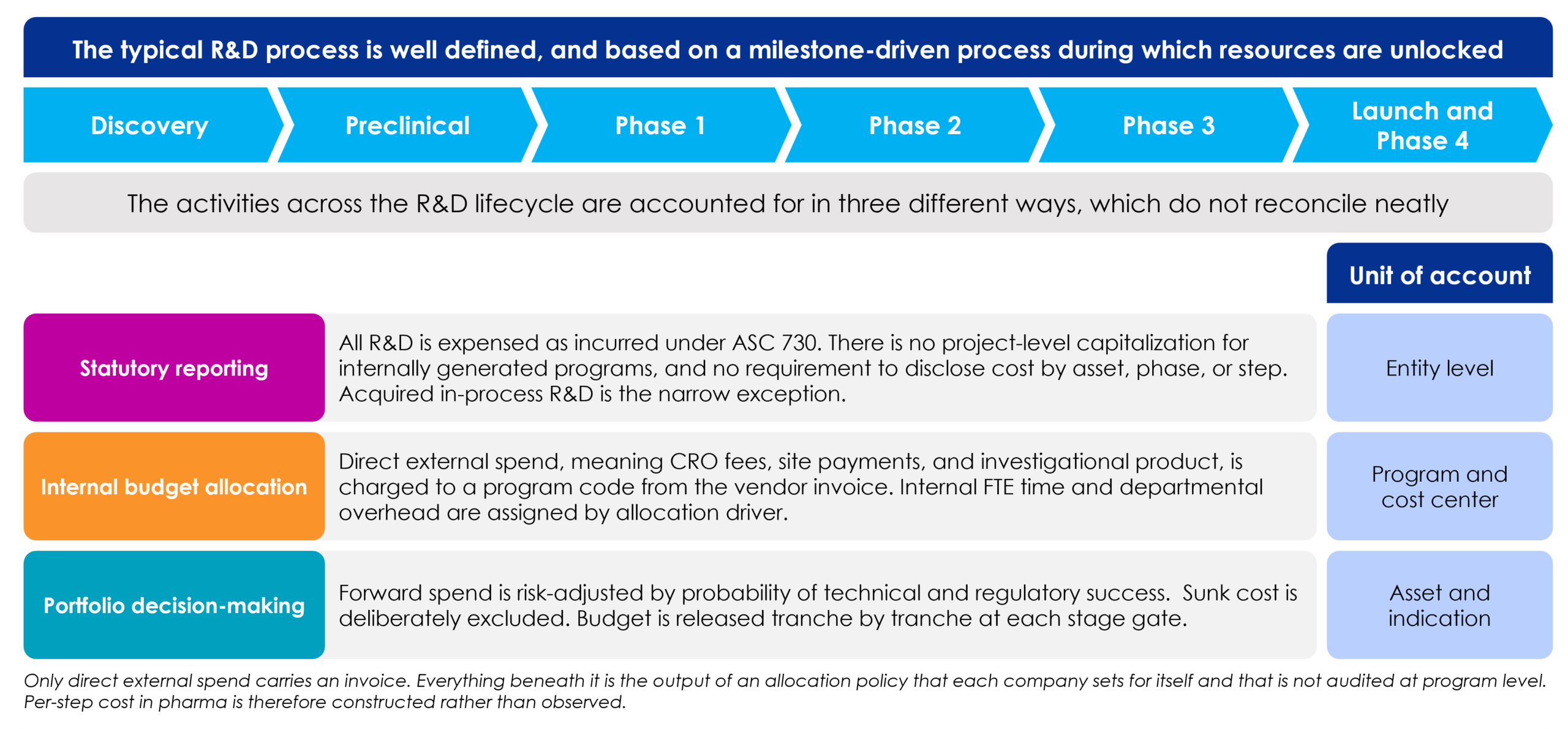
Figure 2 provides an illustrative and non-exhaustive overview of various activities that take place during the development process, the overlap in how costs can be accounted for, and the ability to be resolved at the asset level. This example highlights the difficulty in R&D cost tracking, allocation judgement, and the risk of misreporting, under or double counting. This complexity only grows when a product is co-developed, has multiple indications, complex protocols, or involves foreign-domiciled companies with different tax, accounting, and financial reporting practices than U.S.-based companies.
Figure 2: Example R&D Activities, How Their Costs Are Accounted For, & Ability to Resolve at the Asset Level
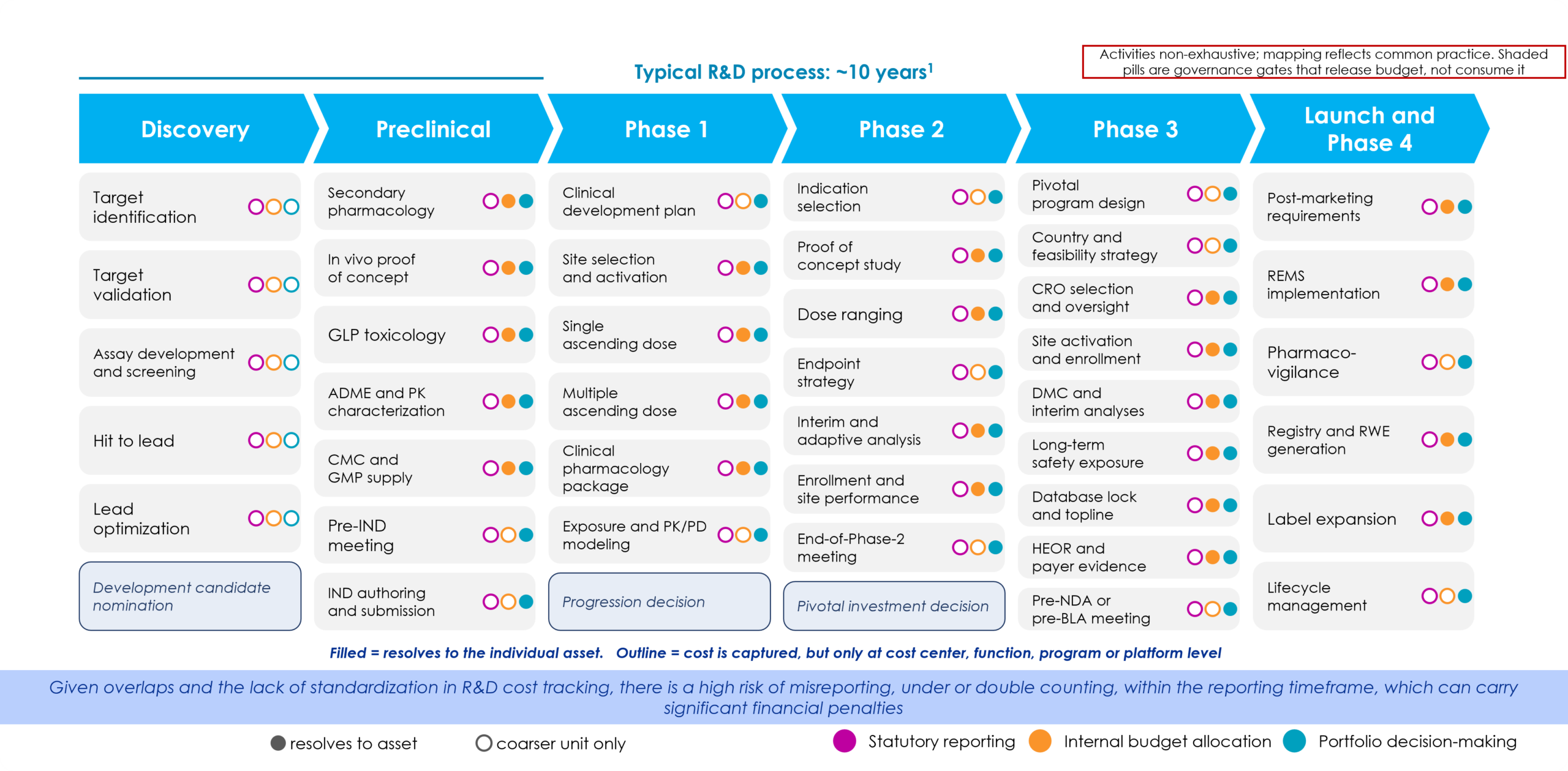
As a result, when it comes to specific assets, only direct external spend is easily observed. Each subsequent cost layer is based upon an unaudited allocation policy. At no step in the R&D process are there statutory reporting requirements at the asset level. Moreover, drug development stretches over a decade or more, which further compounds the challenge to reduce total lifecycle direct, capitalized, and overhead costs per asset to a single number.
Where the IPAY Framework Runs Into Difficulties
Section C asks questions around three key themes: costs related to the selected drug, costs of failed or abandoned products with the same mechanism of action, and global and U.S. net revenue. None of the three align with how R&D costs are actually structured.
Because no existing accounting standard governs a per-asset lifetime cost, every submission is a retrospective reconstruction. Different allocation policies (e.g., for indirect cost, shared platforms, and terminated programs) can each be defensible under US GAAP, and none is prohibited by the proposed instrument, yet they can produce materially different reported totals on identical underlying spend. The figure CMS receives therefore measures each manufacturer’s allocation policy at least as much as it measures the economic cost of the asset.
Principles in literature sources cited within CMS guidance1,2 are inconsistently implemented, borrowing the allocation logic of the development cost literature while declining the capitalization and portfolio failure conventions that produce the figures that literature reports.
Traceability is weakest in discovery—exactly the same stage where CMS asks for “basic pre-clinical research” cost—and it fragments further when assets are co-developed, since no single partner holds a complete record of program cost.
The failed-product question compounds this challenge. Mechanism of action is a categorization that is applied in hindsight, discovery portfolios are organized or funded around targets, platforms, and therapeutic areas, and programs terminated before candidate nomination often carry no asset identifier at all.
The methodology also excludes other real costs. Partnership and acquisition costs are disallowed, and indirect allocation is permitted only for pre-clinical research but not for clinical phases. Recoupment is then assessed against that reduced figure, so it appears earlier than the economics support. The free-text methodology fields add additional exposure, requiring manufacturers to commit unaudited allocation judgments to the record, with no defined compliant methodology and no safe harbor for good-faith estimates.
Last, but not least, the reporting captures cash R&D expenditures but may not fully reflect the economic cost of development. While CMS requires inflation-adjusted costs and permits certain non-monetary compensation to be valued at fair market value, the methodology does not appear to account for the opportunity cost of capital committed over periods that can span a decade or more. As a result, reported R&D costs may understate the full economic investment required to develop and recoup the asset.
What Comes Next
As CMS considers stakeholder comments, several considerations are worth exploring:
- whether indirect allocation might extend to the clinical phases rather than pre-clinical research alone;
- whether partner and acquisition costs could be recognized;
- how the tension between cash-outlay and inflation-adjusted figures might be resolved; and
- how the failed-product definitions could be aligned.
All these considerations would potentially paint a more complete picture of total costs yet create even more administrative burden for companies without solving the significant variability that will continue to exist between companies and products. Because CMS’s use of manufacturer data in price setting is opaque and the government cannot readily validate or compare asset-level development costs, greater precision in R&D reporting is unlikely to justify the added burden.
Instead, an attestation-based model allowing manufacturers to confirm recoupment of R&D costs through use of an officer-certified attestation checkbox may optimize this process for both manufacturers and for CMS. Under this model, manufacturers would attest to whether R&D costs have been recouped and would identify the direct and indirect cost categories involved, without dollarizing them. That approach aligns with how R&D cost is actually recorded. Manufacturers would face a substantially lower administrative burden and less exposure from committing unaudited allocation judgments to the record, and CMS would receive a defensible, officer-certified answer in place of reconstructed figures that cannot be reliably compared across companies. Attestation would address the statutory question of recoupment directly, without demanding numbers that no manufacturer can produce on a comparable basis.
References:
- Wouters OJ, McKee M, Luyten J., Estimated Research and Development Investment Needed to Bring a New Medicine to Market, 2009-2018. JAMA. 2020;323(9):844–853. doi:10.1001/jama.2020.1166.
- Drummond MF, Sculpher MJ, Torrance GW, O’Brien BJ, Stoddart GL., Methods for the Economic Evaluation of Health Care Programme. 3rd ed. Oxford, UK: Oxford University Press, 2005,