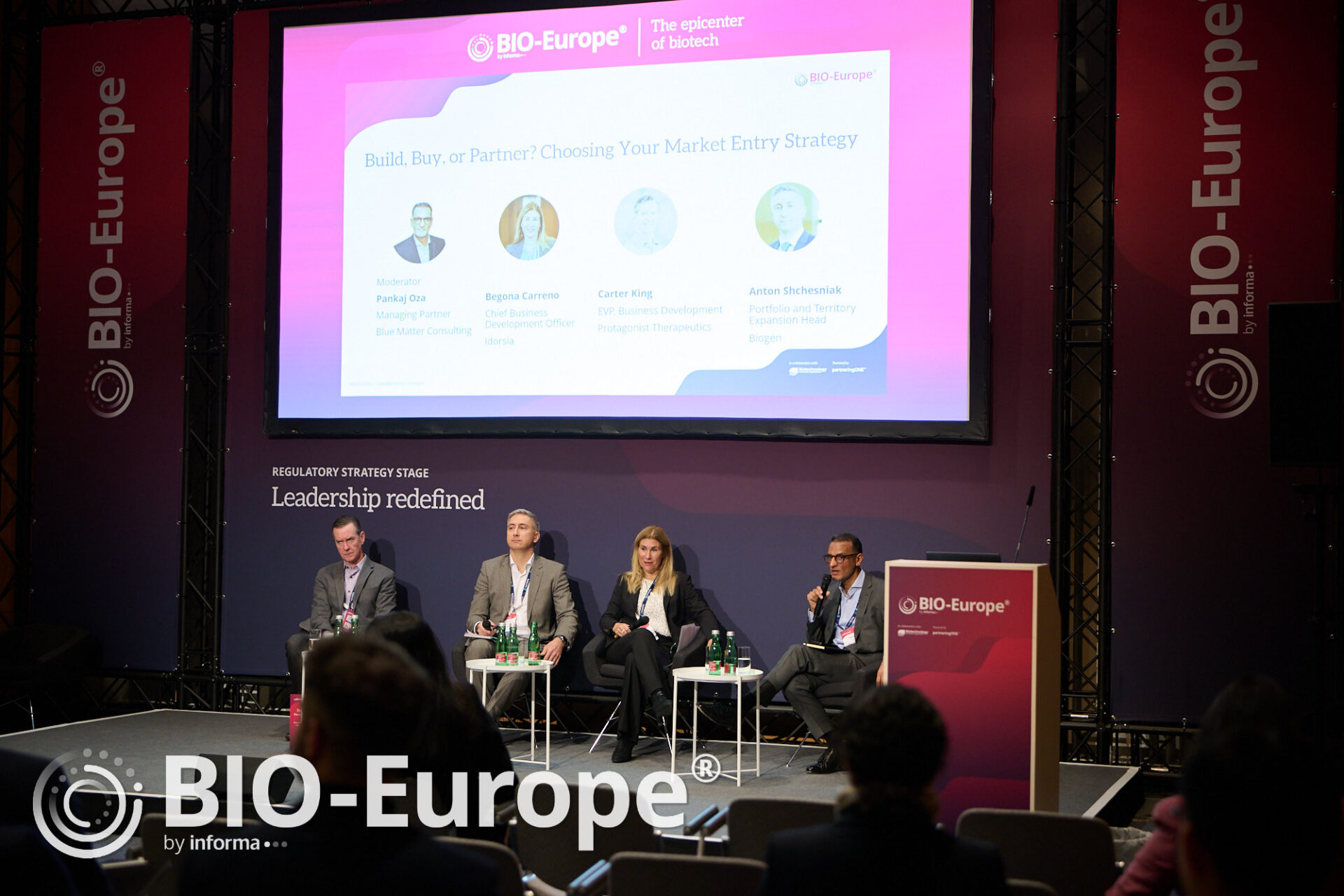
Panel Discussion Recap – BIO-Europe, 9-Nov. 2026
Executive Summary
For a biotech company approaching commercialization, few choices have a more lasting effect than how it enters the market. It can license or partner with an established regional player, build its own commercial organization and launch independently, or combine the two. Each path changes the value the company ultimately captures, the capital it must commit, the risk it absorbs, and the organization it becomes.
At BIO-Europe 2026, a Blue Matter–sponsored panel of senior biopharma leaders discussed how companies should make that choice. Their central message was that market entry strategy is not a late-stage commercial exercise. It should start at company formation, be governed explicitly, be revisited as data and markets change, and be grounded in a realistic view of the therapy area, the regulatory and reimbursement landscape and what a partner would genuinely add. This paper summarizes the discussion and the practical lessons for leadership teams.
Introduction
BIO-Europe is Europe’s largest and longest-running partnering conference for the global biotechnology and biopharmaceutical industry. Its 32nd edition took place in Cologne from 9 to 11 November 2026.
Blue Matter Managing Partner, Pankaj Oza moderated an opening-morning panel, Build, Buy, or Partner? Choosing Your Market Entry Strategy. The panel brought together senior biopharma leaders whose companies have taken different strategic paths across regions. They shared their experiences, the lessons they have learned, and the considerations they would put in front of companies at an early stage of making that key decision.
| Speaker | Role | Organization |
|---|---|---|
| Begoña Carreño | Chief Business Officer | Idorsia |
| Anton Shchesniak | Head, Portfolio & Territory Expansion (Intercontinental Region) | Biogen |
| Carter King | EVP, Business Development | Protagonist Therapeutics |
| Pankaj Oza | Managing Partner | Blue Matter |
The audience included a mix of preclinical, early clinical, and Phase 2+ companies. Most had given market entry strategy some thought, but few had a clear vision for commercialization. By the end of the session, several said they now saw it as a priority.
Commercialization Is Rarely a Day-One Priority, but It Should Be
At a meeting like BIO-Europe, most companies are focused on identifying assets, advancing the pipeline, raising money, and building a team. Commercialization tends to be deferred until decision makers believe the data justify it. The panel argued that this sequencing is a mistake, because the market entry decision is bound up with almost every other strategic choice a company makes.
Part of the difficulty is that “market entry strategy” means different things to different people. For some companies it is about commercial infrastructure, footprint and coverage; for others it is about launch sequencing and prioritization. Whatever the definition, it must cover market access pathways, regulatory frameworks, the capabilities needed on the ground and how capital is allocated across options from early to late stage. At its core, it answers two questions: where will the company play, and how will it execute? The answers depend on the company’s capital and its scientific, regulatory and commercial resources, and on what a partner would add.
The panel found it useful to think of the decision in three layers:
- Corporate strategy establishes where the company stands today, including its constraints, what its investors expect and what it needs to survive and thrive in its next phase.
- Market entry strategy determines which markets to target and how to approach them.
- Commercial strategy defines how to win in each of those markets with the product the company has, including what data it needs to generate.
Early in a company’s life, the corporate layer carries the most weight. Its investor base and how much latitude it has largely determine which market entry options are realistically open.
Building an asset or building a company
One of the earliest and most consequential choices is whether the goal is to build an asset or to build a company. Building an asset means maximizing the value of a program and then exiting, typically through M&A. Building a company means using the asset as the foundation for a broader pipeline and organization. From the outside the two can look identical, but they lead to very different strategies.
A company-building ambition generally means retaining as much control as possible over development and commercial strategy, for example by preferring a regional partnership or co-development arrangement to a global out-licensing deal. If the aim is to become a fully integrated company, research-led organizations need to identify their commercial capability gaps early and bring that expertise in-house or alongside the team, rather than discovering the gaps on the eve of launch.
Start on Day Zero
The panel was unanimous that market entry thinking should begin when the company is formed. Starting early is less about committing to a model prematurely than about letting commercial reality inform the decisions that are hardest to reverse later, particularly trial design and the evidence package.
Understand the therapy area and the market before you need to
Each therapy area demands different capabilities, and the differences between primary care, specialty medicine, vaccines, and rare disease are large. Companies that are strong in one area can fail in another if they underestimate the market. Leaders should understand early what the call points look like, how hard it will be to gain share of voice and break into the market, and how access works, and then work backwards from those realities.
Therapy area also shapes the likely model. In rare disease it is more feasible for a company to become an integrated organization, whereas large immunology and inflammation indications usually require a pharma partner. In pioneering rare diseases, the infrastructure may not yet exist at all. It must be built by listening to the market and the medical community and by working with patient advocacy groups.
Bring the outside view in early
Panelists offered several practical ways to put day-zero thinking into practice. First, ask potential partners early what they would need to see in the asset. Their answers shape how the company differentiates its program, and the advice costs nothing. Second, bring commercial input into development. Phase 3 trials have failed because of poor design rather than a poor asset, and commercial perspective on endpoints, comparators, and target populations can prevent that. Third, make use of the much better business intelligence tools now available to track competitors and evolving standards of care. A placebo-controlled design that is acceptable today may not be tomorrow. Finally, treat the company itself as a portfolio: the organization is an asset in its own right, with individual asset investments nested inside it.
The panel added one caution. Companies should seek broad advice, but should not rely on pharma alone to define their value-maximizing strategy because the same companies may also be competitors. Nobody knows the asset as well as the team that developed it.
Case in point: Tepezza® and the value of conviction
When Horizon Therapeutics was preparing to bring Tepezza® to market for thyroid eye disease, it was not obvious whether ophthalmologists or endocrinologists would drive prescribing, and larger potential partners were uncertain about the opportunity. Horizon saw the asset as core and would not partner without a strategically sound deal. Instead, it focused intensely on the launch, building a deep understanding of the patient journey and the physicians involved.
Following its approval in 2020, Tepezza® generated roughly $1.7bn in its first full year on the market and close to $2bn the following year. In December 2022, Amgen agreed to acquire Horizon for $27.8bn. The panel cited the example to show how a focused company with deep knowledge of its asset can outperform larger players.
Aligning the Organization Behind the Decision
Panelists agreed that internal stakeholders are usually harder to align than external ones. That’s as true in large pharma, where R&D and commercial functions compete for capital, as it is in a small biotech with a handful of decision-makers and a demanding investor base.
The practical answer is governance, established early if it does not already exist, with shared decision criteria and KPIs. The panel recommended agreeing on three scenarios up front: a base case, a blue-sky case and a downside case, such as a regulatory setback or data that are only equal to competitors. For each, the team should define its options and the pivot points that would trigger a change of course. Working backwards from the target outcome to the capital and capabilities required makes the trade-offs visible. Governance also needs to be able to recalibrate quickly when circumstances change, without losing sight of the company’s longer-term vision.
Staying the course or pivoting
Investors, partners and the market will push a company in different directions. The panel framed the question not only as how to stay on course, but whether the course is still the right one. Strategies should be revisited systematically against new data, inbound partner interest, and market changes. Companies that choose to stay committed should be able to make a credible case for more time or capital. Those that cannot make that case should have a Plan B and a Plan C ready.
Case in point: a hybrid launch that evolved with the market
One recent insomnia launch began with a contracted specialty salesforce calling on neurologists and psychiatrists across the US, Europe, and Canada. When primary care proved to be a key driver of growth, the company added partners to cover those prescribers, along with regional partners in Asia, the Middle East, and North Africa. It now manages seven to eight partnerships around a single product, an example of a hybrid model adapting as the market revealed where demand existed.
The risk also runs the other way. Some companies entered smaller markets with uncertain regulatory or access pathways, built infrastructure there and then had to exit or partner out, effectively paying twice. Resilient expansion depends on clear capital allocation decisions and disciplined execution.
Geographic Expansion in a Changing World
The traditional model, in which a company launches in the US first and captures roughly another 20% of value from the rest of the world, is being disrupted. The panel pointed to the introduction of most-favored-nation (MFN) pricing in the US, the rise of China as a source of innovation and competition, and the growing importance of new territories.
As a result, the familiar sequence of US, then Europe, then Japan, then the rest of the world no longer fits every product. This is especially true in rare disease, where regulators other than the FDA and EMA are increasingly approving first. MFN also raises new pricing trade-offs. For example, a company now has to ask whether launching first in a lower-priced market such as Brazil is worth the potential reference-price consequences.
Regulatory harmonization becomes critical once a program enters the clinic. A data package that does not reconcile FDA and EMA requirements can cut off a substantial share of global value. Reimbursement needs to be planned country by country. A single centralized European approach may not be enough, as different evidence may be needed for Germany, France, the Low Countries, the Nordics and the UK, where NICE has its own requirements. Indications may also be valued differently in Asia. Some regions require patients from their own countries in the data, so companies should consider accelerating development to include them and should talk to local authorities early to understand the path to market.
Two further points were raised. Early access programs are often underestimated and should be planned well before launch, particularly in rare disease. And speed matters: arriving late in a market can mean ceding first-mover advantage to competitors.
How much of this a company should act on depends on its stage. Young companies should first focus on what keeps them alive and on the story they are telling investors: is the value really in Asia or Latin America, or mostly in the US and Europe? As companies mature, they gain room to optimize launch sequencing. In either case, this is not something a company can do alone. On-the-ground expertise, whether from partners, affiliates or advisers, is essential.
Getting Partnerships Right
Partnering strategy is now a major source of value creation in biotech, so deal structure deserves close attention. The panel’s starting principle was that a partner should bring infrastructure, expertise and resources, not just capital. If a partner brings only money, raising that money directly may be the better option.
Panelists also shared lessons on deal terms that have caused problems in practice. Splitting indications between partners creates complications for pharmacovigilance, intellectual property, and commercial execution. Opt-in and option rights are increasingly favored by pharma because they let partners delay commitment and cherry-pick. If a company agrees to them, they should be defined as tightly as possible. Co-development and co-promotion arrangements without clear governance, roles, accountabilities, and KPIs tend to produce disputes and slow decisions. And exclusive distribution deals that rely on “commercially reasonable efforts” without set targets can lead to endless renegotiation over investment and priority.
The overarching principle was to look for partners who are fully committed to the company’s vision and will sign up to it, rather than partners who are only partly committed under certain conditions.
Conclusion: Questions for Leadership Teams
The panel’s lessons apply whether a company is preclinical or preparing for Phase 3. They can be distilled into a set of questions that leadership teams and boards should be able to answer well before launch:
- Have we started? Market entry thinking should begin at company formation, not once pivotal data arrive.
- Are we building an asset or a company? The answer determines how much control to retain and which capabilities to build.
- Are we aligned? Internal stakeholders should agree on base, upside and downside scenarios, with defined options and pivot points for each.
- Whose advice are we relying on? Outside input, including from potential partners, is valuable early, but the company must remain the expert on its own asset.
- Is this still the right course? Strategy should be revisited regularly against new data, partner interest and market change, with alternatives ready.
- Have we planned for geographic complexity? Regulatory harmonization, country-level reimbursement, MFN pricing and early access all shape where and when to launch.
- Will our partners bring capability and commitment? Choose partners for more than capital, and structure deals to avoid ambiguity.
Build, buy or partner is rarely a single decision made once. The companies that capture the most value treat it as a strategic discipline that starts early, is governed explicitly, and evolves with the evidence.
Contact Us to discuss how Blue Matter can help you build corporate and asset strategies to optimize value.