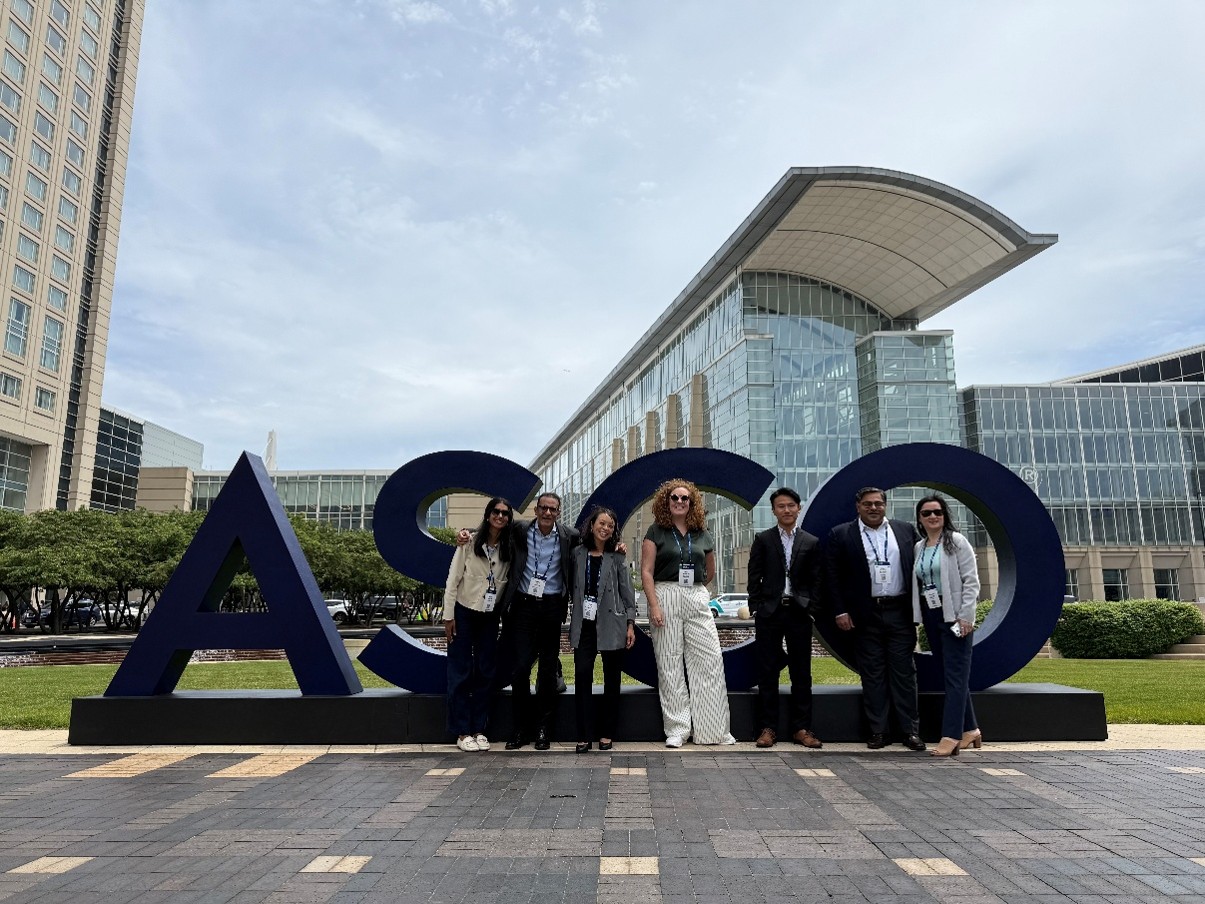
Recently, members of the Blue Matter team attended the annual meeting of ASCO (American Society of Clinical Oncology), from May 29 to June 2 in Chicago. More than 44,000 people attended this key meeting and it would be impossible to provide a full recap of such a large-scale event. However, we did notice some key themes and some groundbreaking data that certainly justify a recap.
If ASCO 2026 had a thesis, it was this: targets we once called “undruggable” are falling, and the antibody-drug conjugate (ADC) wave shows no sign of cresting. The single loudest moment came from pancreatic cancer, while breast and lung cancers continued their steady reshaping with new modalities and targeted therapies. Below are the themes our team thought rose to the top.
1. Pancreatic cancer’s plenary moment: targeting RAS finally pays off
The meeting’s marquee result was RASolute 3021, presented in the plenary session by Brian Wolpin, MD, MPH (Dana-Farber Cancer Institute) and published simultaneously in the New England Journal of Medicine3. This phase 3 trial randomized 500 patients with previously treated metastatic pancreatic ductal adenocarcinoma (mPDAC) 1:1 to once-daily oral daraxonrasib, a multi-selective RAS(ON) inhibitor that hits mutant and wild-type RAS, versus investigator’s choice of chemotherapy.
The numbers were striking for a disease where second-line chemotherapy typically delivers a median overall survival (OS) of 6–7 months:
- Overall Survival (OS): 2 vs 6.7 months in the overall population (HR 0.40; p=4.6×10⁻¹¹). In the RAS G12 population, 13.2 vs 6.6 months (HR 0.40).1,2
- Progression-Free Survival (PFS): 2 vs 3.6 months overall (7.3 vs 3.5 in RAS G12).2
- Objective Response Rate (ORR): 6% vs 11.2% overall (33.2% vs 11.8% in RAS G12).2
- 12-month OS: roughly 53% vs 17%.2
- Tolerability: grade ≥3 adverse events were less common with the targeted oral agent than with chemo (43.6% vs 57.5%), and discontinuations due to adverse events were dramatically lower (1.2% vs 11.2%). Patients also reported delayed deterioration in cancer-related pain and quality of life.2,5
In her discussion, Jennifer Knox, MD (University of Toronto) framed it bluntly, calling RAS-targeting a “game-changer” and pointing to daraxonrasib as a new second-line standard of care.4
Why it matters beyond pancreatic cancer
RAS mutations drive a huge fraction of human cancers, and a single agent active across G12, G13, Q61, and wild-type RAS has obvious applicability to lung and colorectal disease. Watch the regulatory path closely: Revolution Medicines has signaled an FDA filing supported by a Commissioner’s National Priority Voucher, and the first-line RASolute 303 trial is already enrolling.5 The key question that everyone is asking is this: What happens when daraxonrasib moves to the front line, or into earlier-stage disease?
2. Breast cancer’s ADC arms race: now with bispecifics
Triple-negative breast cancer (TNBC) was the clearest illustration of how crowded the ADC space has become, with multiple agents and multiple settings all landing at the same meeting.
- Iza-bren (izalontamab brengitecan) stole the TNBC spotlight. This potentially first-in-class EGFR×HER3 bispecific ADC (SystImmune/Biokin, partnered with Bristol Myers Squibb) was tested in the phase 3 PANKU-Breast02 trial in pretreated metastatic TNBC (1–2 prior lines). At an interim analysis it hit both primary endpoints: OS 15.9 vs 12.5 months (HR 0.60; p=0.0019), PFS 8.5 vs 3.1 months (HR 0.29), and a confirmed response rate of 51.7% vs 20.5%. A bispecific ADC clearing both survival bars is a notable proof point, though it’s worth flagging this was a China-based study, which shapes how Western regulators will read it.6
- Datopotamab deruxtecan (Dato-DXd) in TROPION-Breast02 (first-line, immunotherapy-ineligible mTNBC) showed meaningful delays in time to next therapy (10.9 vs 5.6 months; HR 0.49) plus PFS2 and time-to-second-subsequent-therapy benefits (evidence the advantage carries past first progression.)7
- Sacituzumab govitecan (SG) continued to build its first-line case. New ASCENT-03 (SG monotherapy, PD-(L)1-ineligible) biomarker analyses showed benefit across Trop-2 expression quartiles, BRCA status, and HER2 subgroups (i.e., the benefit isn’t confined to the highest Trop-2 expressers). ASCENT-04 (SG + pembrolizumab, PD-L1-positive) added PFS2 data showing the benefit persists beyond first progression.8
The real takeaway is the sequencing problem. As one ASCO panel noted, in TROPION-Breast02 only about 20% of patients went on to receive any second-line therapy, a reminder that “more options” only helps if patients reach them. With SG, Dato-DXd, and now bispecific ADCs converging on overlapping TNBC populations, the clinical challenge is shifting from “is there a drug?” to “in what order?”
3. HER2-positive disease: T-DXd moves earlier, and new modalities emerge
The HER2 story is one of intensification at the front and innovation around tolerability:
- DESTINY-Breast09 established trastuzumab deruxtecan plus pertuzumab as a first-line option with a clear PFS advantage (first reported in 2025), and discussion at ASCO 2026 centered on how this reshapes the long-standing taxane-based first-line standard.8
- Earlier-stage data continued to mature, including the final KEYNOTE-522 analysis in high-risk early TNBC and ongoing escalation/de-escalation debates in early HER2+ disease.8
- On the horizon: anbenitamab, a biparatopic HER2 antibody being explored in the neoadjuvant setting as a potentially less toxic alternative to ADC-heavy regimens. This is one to watch as the field looks to reduce toxicity without losing efficacy.9
4. HR+/HER2– disease: liquid biopsy goes prime time, and the SERD wars heat up
Hormone receptor-positive disease delivered some of the meeting’s more strategically interesting stories.
- SERENA-6 is arguably the most practice-shaping HR+ concept: using serial ctDNA to detect an emergent ESR1 mutation before clinical progression, then pre-emptively switching from an aromatase inhibitor to the oral SERD camizestrant (plus continued CDK4/6 inhibition). The switch delivered a roughly 7.6-month median PFS gain, with about a third of patients still progression-free at 24 months.10
- Giredestrant told a tale of two settings. In the adjuvant lidERA trial, the oral SERD reduced invasive disease-free survival events versus standard endocrine therapy across menopausal status (roughly 35% improvement premenopausal, 26% postmenopausal; NDA submitted). But in first-line metastatic disease, persevERA (giredestrant + palbociclib vs letrozole + palbociclib) missed its primary endpoint, showing only a numerical ~11% PFS improvement. The nuance: a missed primary with a hint of activity is still a missed primary, but it doesn’t erase the adjuvant opportunity.11
- De-escalation got real attention, as well. The OPTIMA trial suggested some clinically high-risk, ER-positive early breast cancer patients may safely skip chemotherapy based on tumor biology,10 and a large real-world analysis raised an intriguing signal that GLP-1 receptor agonists may be associated with lower HR+/HER2– incidence and improved survival in overweight, nondiabetic women — early and hypothesis-generating, but a sign of where adjacent science is pushing.7
5. NSCLC’s burgeoning revolution: PD-(L)1×VEGF bispecifics take aim at the “Keytruda ceiling”
The meeting’s other practice-changing signal came in lung cancer, where a new class of bispecific antibodies—fusing PD-1 or PD-L1 blockade with VEGF inhibition in one molecule—took direct aim at single-agent checkpoint inhibition. In the plenary, HARMONi-6, the first China-only dataset ever selected for the ASCO plenary, shared provocative data from ivonescimab (Akeso/Summit; a first-in-class PD-1×VEGF bispecific):
- Overall survival (OS): 9 vs 23.7 months (HR 0.66; p=0.0017), a 34% reduction in the risk of death, and the first regimen to beat an active PD-1 inhibitor plus chemo on OS in first-line squamous NSCLC.12
- Benefit regardless of PD-L1: the OS advantage held in both PD-L1–negative (HR 0.64) and PD-L1–positive (HR 0.68) patients, notable in a tumor type rich in low-PD-L1 cases that respond poorly to checkpoint inhibition alone.12
- A safer way to deliver anti-VEGF: building VEGF blockade into the antibody brought a potential anti-angiogenic benefit to squamous patients, in whom standalone VEGF inhibitors are contraindicated for bleeding risk, with grade ≥3 hemorrhage in just 2.6% of patients.12
However, the data drew scrutiny: discussant Julie Brahmer, MD, called HARMONi-6 “groundbreaking” yet “provocative,” noting that an almost entirely male, younger, China-only population limits how far the result extrapolates13.
Two other China-originated PD-(L)1×VEGF bispecifics added to the momentum: BioNTech/BMS’s pumitamig (BNT327), with confirmed responses up to 72.7% in a global phase 214, and Pfizer’s PF-08634404 (in-licensed from 3SBio), at 67.6% as monotherapy15. With all three leading molecules discovered in China and licensed West, the class looks real and squamous NSCLC may be its beachhead, but whether the win travels rests on the global confirmatory readouts due over the next 12–18 months.
6. ALK-positive disease: new benchmarks with lorlatinib, and upcoming next-generation challengers
ALK+ non-small cell lung cancer (NSCLC) continues to see notably durable frontline benefit with on-market ALK tyrosine kinase inhibitors (TKI), alongside a maturing pipeline of next-generation therapies.
- Lorlatinib in CROWN provided 7-year update, following already-unprecedented 5-year follow-up data presented at ASCO 2024, reinforcing long-term benefit of lorlatinib and longest PFS reported in advanced NSCLC. Median PFS was still not reached with lorlatinib vs 9.1 months with crizotinib (HR 0.19) at median follow-up of ~83 months, and patients randomized to lorlatinib without a PFS event at the end of 24 months had a 79% probability of survival without progression at seven years.16,17
- Neladalkib in ALKOVE-1 demonstrated the ALK-selective TKI’s activity in heavily pre-treated patients, with ORR by blinded independent central review (BICR) of 31% overall (95% CI, 26%-37%). Data supported the recent NDA in this population, while preliminary data in the TKI-naïve cohort also reinforced rationale for the ongoing ALKAZAR trial investigating neladalkib vs alectinib in the frontline setting. This ASCO presentation also notably preceded GSK announcement on June 9 of plans to acquire Nuvalent for $10.6 billion, built around neladalkib and zidesamtinib, a ROS1 inhibitor.17,18
7. AI moved from “interesting” to “operational” and Medical Affairs needs a strategy for it
ASCO made it official this year: AI got its own dedicated session track. This wasn’t theoretical anymore. AI is now being used to interrogate drug targets, guide clinicians’ decisions beyond what has traditionally been available, and assess prognostic outcomes from digital pathology images. The highest-engagement content centered on concrete, point-of-care applications such as cancer detection, trial matching, and clinical decision support.
For Medical Affairs, this creates a dual mandate. First, teams need to understand how AI-enabled tools (like Tempus’ multimodal models or Artera’s digital pathology platform) are reshaping the information environment that their KOLs operate in because those tools are influencing treatment decisions in real time. Second, there’s an internal opportunity: newer biotechs are already integrating real-world signals more dynamically and adapting physician engagement market by market, using AI to close the gap between data generation and field execution. Medical Affairs teams that adopt similar approaches to literature surveillance, congress intelligence, and MSL engagement planning will operate faster and more precisely than those sticking to legacy workflows.
ASCO 2026 reinforced that the pace of evidence generation in oncology is accelerating. Medical Affairs is the function best positioned to translate that into actionable scientific dialogue, but only if the team’s infrastructure, tools, and scientific platform keep up.
Three common currents
Three currents ran beneath nearly every session worth watching:
- “Undruggable” is becoming a historical term – While RAS was the headline, the broader message is that mechanism-led medicinal chemistry is reaching targets that defined the limits of oncology for a generation.
- ADCs are now a platform – With bispecific ADCs joining the established players, the differentiation battle is moving to target selection, payload, and sequencing.
- The tumor is being read in real time – ctDNA-guided switching (SERENA-6) and biomarker-stratified ADC benefit (ASCENT-03) both point to a future where treatment decisions are made on molecular signals and not just imaging.
For pancreatic cancer specifically, the mood was best captured by a single discussant slide: unprecedented hope and progress, at last. For the rest of oncology, ASCO 2026 was a reminder that the precision-medicine playbook is finally compounding.
End Notes
- Wolpin BM, Wainberg ZA, Hendifar AE, et al. Daraxonrasib vs chemotherapy in previously treated mPDAC: RASolute 302. 2026 ASCO Annual Meeting, Abstract LBA5 (J Clin Oncol 2026;44[suppl 17]:LBA4005). org
- The ASCO Post. “Daraxonrasib Nearly Doubles Survival in Previously Treated Metastatic Pancreatic Cancer.” June 1, 2026. com
- Wolpin B, Park W, Garrido-Laguna I, et al. Daraxonrasib in previously treated advanced RAS-mutated pancreatic cancer. N Engl J Med. 2026. org
- Knox JJ. Discussant: “Targeting RAS is a Game-Changer for Pancreatic Cancer.” 2026 ASCO Annual Meeting. (As reported in ASCO meeting coverage.)
- Revolution Medicines. “ASCO Plenary Presentation Highlighting Results from Pivotal Phase 3 RASolute 302.” Press release, 2026. revmed.com
- Bristol Myers Squibb / SystImmune. “Izalontamab Brengitecan (Iza-Bren) Demonstrates Improvements in OS and PFS…” Press release, May 31, 2026 (PANKU-Breast02). bms.com
- Targeted Oncology. “ASCO 2026 Breast Cancer Highlights: Beyond the LBAs.” (Dato-DXd / TROPION-Breast02; giredestrant adjuvant; GLP-1 RA analysis.) com
- “Breast Cancer Highlights From ASCO 2026.” (ASCENT-03/04; KEYNOTE-522; DESTINY-Breast09.) oncodaily.com
- Docwire News. “ASCO 2026 Preview: Breakthroughs in TNBC and HER2+ Breast Cancer.” (Anbenitamab biparatopic HER2 antibody.) com
- Breast Cancer Research Foundation. “A Scientist’s ASCO 2026 Key Takeaways.” (SERENA-6; OPTIMA.) org
- Fierce Biotech. “Roche details oral SERD giredestrant’s first-line flop in breast cancer.” (lidERA subgroups; persevERA.) com
- Lu S, et al. HARMONi-6: ivonescimab plus chemotherapy vs tislelizumab plus chemotherapy in first-line advanced squamous NSCLC. 2026 ASCO Annual Meeting, Plenary Session (LBA4); Akeso/Summit Therapeutics press releases, May 31, 2026. akesobio.com; smmttx.com
- Liu A. “ASCO: Akeso’s ivonescimab bests PD-1 inhibitor in lung cancer chemo combos, slashing death risk by 34%.” Fierce Pharma, May 31, 2026 (includes discussant Julie Brahmer’s critique). fiercepharma.com
- BioNTech / Bristol Myers Squibb. “Global data for PD-L1xVEGF-A bispecific pumitamig (BNT327) in NSCLC: ROSETTA Lung-02 interim phase 2 results.” 2026 ASCO Annual Meeting (rapid oral). biontech.com
- “Pfizer showcases oncology innovation and next-generation pipeline at ASCO 2026” (PF-08634404 / SSGJ-707 phase 2 NSCLC data); Pfizer–3SBio exclusive licensing agreement, 2025. pfizer.com
- Lung Cancers Today. “CROWN Trial: Lorlatinib Shows ‘Unprecedented and Highly Durable Benefit’ in Advanced ALK-Positive NSCLC.” com
- “Newer Agents Hope to Raise the Bar in ALK- and RET-Positive NSCLC.” (lorlatinib / CROWN; neladalkib / ALKOVE-1.) onclive.com
- “GSK enters agreement to acquire Nuvalent, Inc.” Press release, June 9, 2026. gsk.com