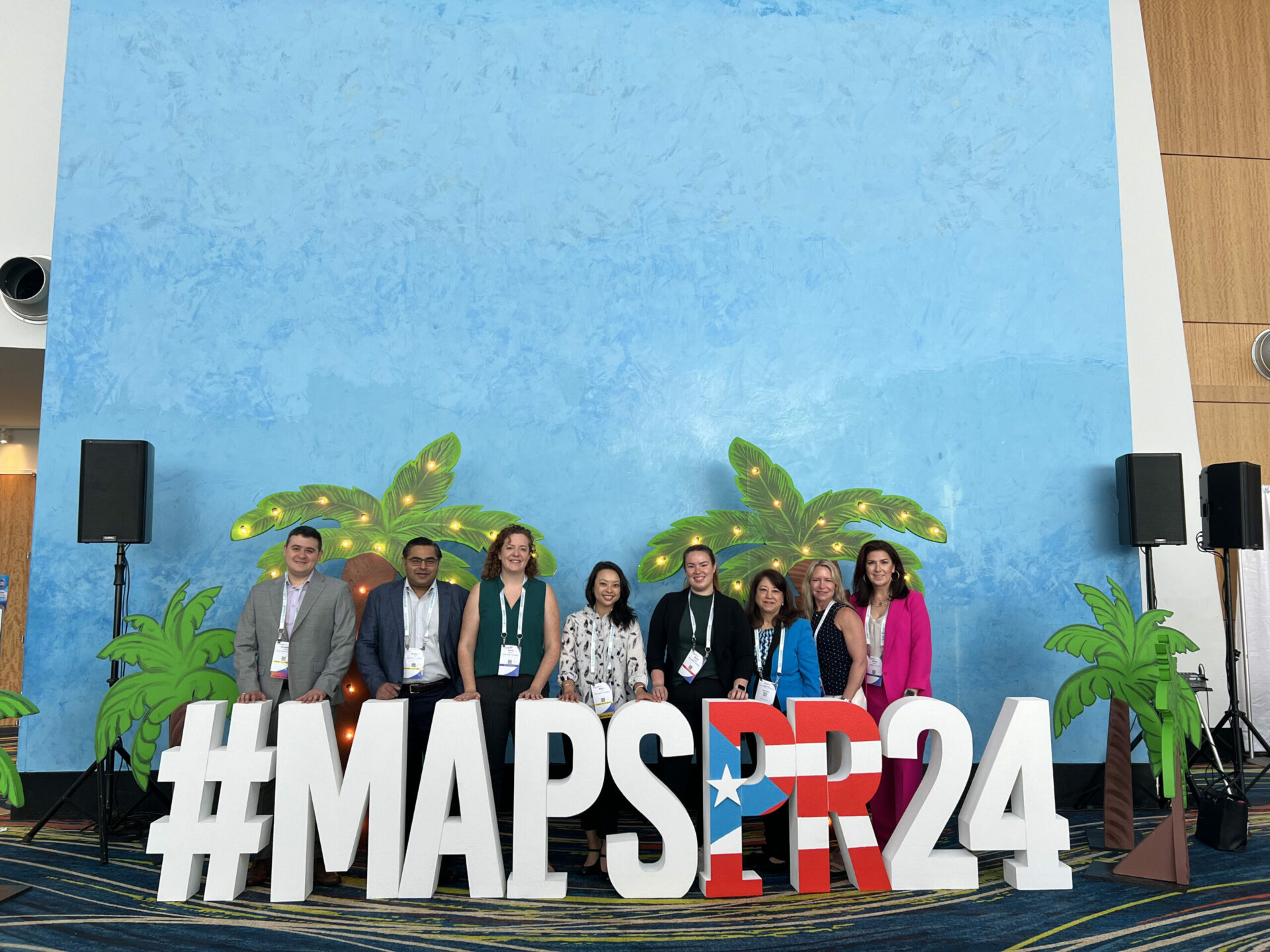
The Medical Affairs Professional Society (MAPS) held its annual Americas meeting in Denver, CO from March 22-25. This meeting is an important one for our Medical Affairs team, which uses it as a major touchpoint for a wide range of clients and colleagues, as well as a great opportunity to see and contribute to the latest developments in the Medical Affairs space.
With more than 1,500 people in attendance and 150+ speakers, it would be impossible to provide a full recap of MAPS Americas. However, as our team members “made the rounds” talking to people and participating in sessions, several key themes rose to the top for us. Below, we provide a brief flyover, offering some thoughts on each.
1. AI in Medical Affairs: Moving from Tool to Core Capability
Artificial intelligence dominated the agenda as a present-day imperative. A standout leadership debate framed the central tension as Rapid Innovation versus Strategic Integration: Is it best to move fast and pilot everything, or build the governance infrastructure first?
Advocates for speed argued that the window to lead in the digital health space is closing, and that organizations that don’t move fast risk losing competitive ground. On the other side, proponents of strategic integration countered that AI is only as good as the underlying data — that you need a solid “Data House” before deploying “AI Windows” — and that inaccurate AI-generated insights could carry real regulatory and patient safety consequences.
The debate landed on a concept called “Responsible Velocity.” This involves a willingness to pilot generative tools quickly, but a commitment not to scale them until they pass a rigorous framework prioritizing data integrity and clinical accuracy. The framing of “innovation vs. integration” was challenged as the wrong lens entirely. After all, the real measure of success isn’t how many AI tools are launched, but the reduction in time-to-insight for clinical decisions.
Across multiple sessions, AI’s role in “rehumanizing” healthcare also emerged as a compelling topic. Rather than replacing clinicians, AI’s greatest potential lies in reducing administrative burdens, thereby freeing physicians to focus on the human dimensions of care. The vision: “AI-empowered doctors” who combine human empathy and judgment with AI’s pattern recognition capabilities. A quote from one of the sessions summed things up nicely: “AI won’t replace doctors and medical affairs professionals, but doctors and medical affairs professionals using AI will replace those not using AI.”
2. From Activity to Impact: Proving the Value of Medical Affairs
If there was a single challenge that cut across every session, it was that Medical Affairs knows it creates value but the field still struggles to prove it in terms that resonate with business leadership.
Multiple sessions tackled this issue. The message was consistent: measuring what MSLs do is no longer sufficient. The real question is what they achieve. Medical Affairs’ job is ultimately to change clinician beliefs and behaviors. Information sharing is simply a means to an end, not the end in and of itself.
Two particularly useful frameworks were presented in this space. The Core Logic Model maps a structured progression from interventions through indicators, outputs, outcomes, and long-term impact, moving beyond activity tracking (e.g., number of programs launched) to capture shifts in HCP behavior, improvements in the patient management funnel, and the clinical and economic impact on society. Complementing this, a session on Clinical Care Gaps introduced an alternative targeted measurement approach: by focusing on a specific subset of patients at a defined stage of the patient journey, teams can systematically ask what care those patients are receiving, where, and from whom. The power of this approach lies in its ability to look upstream of outcomes, enabling Medical Affairs teams to detect meaningful change as it is happening, and more rapidly after efforts have initiated, rather than waiting for downstream clinical results to surface.
Sessions on measuring the impact of a global medical education event reinforced an important practical point: behavioral change is never measurable the day after an event (or even the week after). Meaningful impact measurement requires a multi-phase assessment plan with pre-event, post-event, and follow-up components, and specificity in defining who should change, what they should change, and when that change should be detectable. In addition, it’s critically important to properly set expectations with senior leaders and cross-functional colleagues, ensuring that all are aligned on what metrics are important to measure and how. In short, everyone needs to agree on what the needle is before trying to show how Medical Affairs has moved it.
3. Scientific Communications: Systems, Not Just Manuscripts
Another recurring theme was the need to treat scientific publications as strategic assets rather than just evidence dissemination tools. A 2024 MAPS survey found that fewer than half of respondents had an established process for cross-functional amplification of medical content, even though roughly 80% agreed that publications should influence broader corporate messaging.
The message was pointed: a manuscript without amplification is merely checking a box. True influence requires a systematic, cross-functional approach. Furthermore, medical communications are uniquely positioned to serve as the “connective tissue” that aligns science, strategy, and stakeholders across internal and external teams.
A hands-on workshop brought this to life, challenging teams to build integrated evidence and communication strategies spanning evidence strategy, audience-specific messaging, omnichannel outreach, and measurable KPIs. The takeaway was that publications don’t create impact…systems do.
4. Rethinking the Medical-Commercial Relationship
One of the more provocative debates of the meeting questioned whether the traditional hard firewall between Medical Affairs and Commercial still serves its intended purpose. Participants argued that a more “permeable membrane” — one that acknowledges overlapping objectives like closing clinical care gaps and improving understanding of novel therapies — would better reflect operational reality and support smoother HCP engagement.
This conversation extended into the broader challenge of cross-functional transformation. Speakers who had navigated multi-year digital and scientific communications transformations were clear: technology is never the answer on its own. People, processes, and governance must come first. Cross-functional alignment between Legal, Regulatory, Commercial, IT, and Medical Affairs from day one was described as both the hardest and most critical element. Siloed thinking, the group agreed, kills enterprise-wide impact.
5. The Science of Engagement: Behavioral Principles for MSLs
A well-attended session brought behavioral science into the field medical context, exploring not just what MSLs communicate, but how the human brain encodes, retains, and retrieves information. Practical techniques included:
- Chunking complex data into threes or clear narrative structures
- Anchoring clinical information to patient impact to activate emotional memory
- Using the “40-second replay” – a mid-conversation verbal summary that reinforces encoding and surfaces misconceptions in real time.
Perhaps most compellingly, asking an HCP to teach back a concept was presented as one of the most powerful retrieval techniques available.
The integration of AI into these skills was also highlighted: from simulated HCP conversations for pre-call practice, to post-call transcript analysis that tags behavioral signals, barriers, and next-best questions. The bottom line: scientific exchange is both a science and a skill, and both can be developed.
Looking Ahead
Across every session and debate, a consistent theme emerged: Medical Affairs is at an inflection point. The field has the scientific credibility, the stakeholder relationships, and increasingly the tools. Now, Medical Affairs needs to master the art and science of measuring what truly matters: collaborating across traditional boundaries, and scaling what works. We look forward to seeing you in Miami for MAPS Americas 2027!