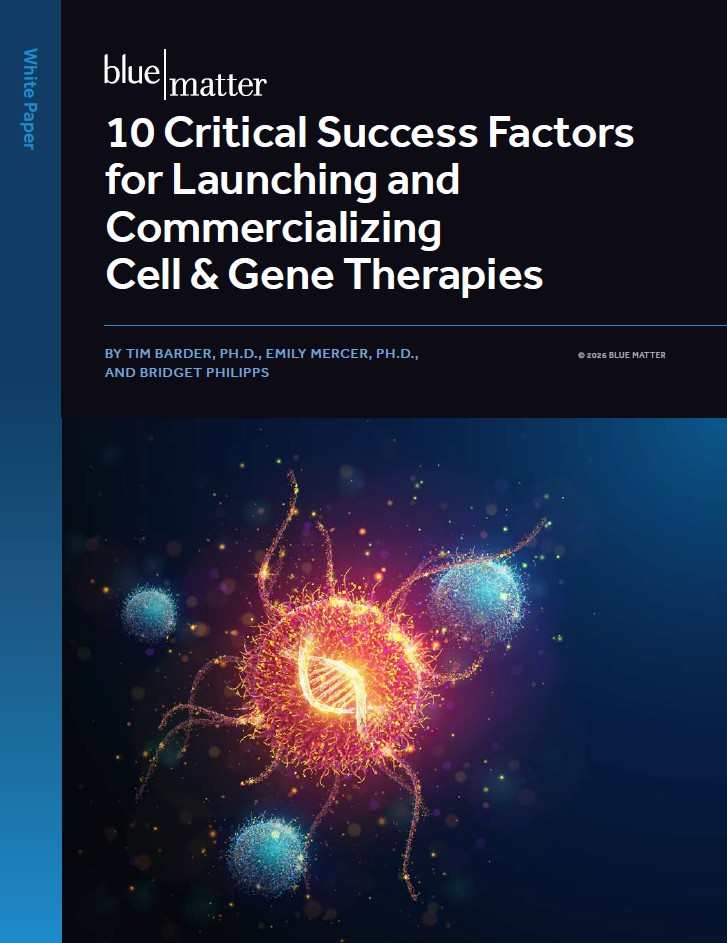
Cell and gene therapies (CGTs) represent some of the most transformative advances in modern medicine. However, they are not immune to the realities of the marketplace, and great science isn’t enough to guarantee successful commercialization. In a recent paper, we introduced 10 critical success factors for launching and commercializing cell and gene therapies. In this blog series, we dive a bit deeper into each success factor to provide some additional insight. In this installment, we address the importance of market education.
Even the most scientifically compelling products can falter commercially without early, sustained investment in market education. As the CGT landscape matures, the gap between clinical promise and commercial performance has widened for many recent entrants, and a lack of stakeholder preparedness is frequently at the root.
Our experience across a range of CGT commercialization engagements has shown us that market education is not a single activity. Instead, it’s a dual mandate spanning both technology education and disease education, each requiring distinct strategies, timelines, and stakeholder approaches.
Technology Education: Earning Trust in a Skeptical Market
Gene therapy as a concept still carries significant baggage. Healthcare providers harbor uncertainty around the long-term effects of genome editing. Patients encounter confusing and sometimes alarming media coverage. Payers question durability and struggle with the economics of one-time, high-cost treatments. These perceptions are not static. Instead, they continue to evolve with every new safety signal, market withdrawal, or competitive headline.
For companies bringing novel or first-in-class CGT modalities to market, technology education must begin early, often more than three years before the anticipated launch. The goal is twofold:
- Build foundational trust in the underlying science
- Differentiate your specific platform from the broader CGT category
This distinction matters enormously. Companies that fail to control the narrative around their technology risk being “lumped in” with negative perceptions driven by competitors or by broader market events entirely outside their control.
Prior launches offer instructive examples. Products like Zolgensma benefited from a clear, well-communicated value story tied to transformative efficacy, while more recent entrants like Roctavian faced headwinds partly rooted in unresolved stakeholder skepticism about durability, a technology-level concern that product-specific data alone could not fully overcome.
Technology education is a tool to address hesitancy and it’s not a demand driver in its own right. Companies that over-index on the novelty of their platform at the expense of traditional marketing fundamentals (e.g., clear positioning, evidence-based messaging, and compelling patient narratives) often find that excitement about the science does not translate into dosing patients.
Disease Education: Finding and Reaching the Right Patients
For CGTs targeting underdeveloped disease areas, especially in rare diseases, the education challenge extends beyond the therapy itself. Many potential patients remain undiagnosed or are managed by providers unfamiliar with emerging treatment options. Companies must invest in raising disease awareness, improving diagnostic pathways, and supporting patient identification, which requires engagement across a broad ecosystem of patients, HCP referrers, multi-disciplinary teams, KOLs, payers, patient advocacy organizations, and caregivers.
This is particularly important in rare diseases where frequently fragmented care pathways and limited provider experience with the condition may create natural barriers to patient flow. Without proactive disease education, even the most effective therapy will struggle to reach the patients who need it most.
Getting the Balance Right
The most successful CGT launches strike an intentional balance between technology and disease education, tailored to their specific market context. A first-in-class gene therapy entering an established disease area may lean more heavily on technology trust-building. A product entering a rare, poorly understood condition may need to invest proportionally more in disease awareness and patient finding. In both cases, the work must start years before commercial launch and engage a wide range of stakeholders with consistent, credible messaging.
At Blue Matter, we have supported CGT companies across this full spectrum, from early-stage biotechs defining their educational strategy for the first time, to established organizations refreshing their approach as competitive dynamics shift. Our work is grounded in deep engagement with the CGT ecosystem, giving us a practitioner’s understanding of what resonates and what falls flat.
Market education may not be the most glamorous element of a CGT launch plan, but it is foundational. Getting it right creates the conditions for every downstream commercial activity to succeed. Getting it wrong, however, can prevent breakthrough science from reaching the patients it was designed to help.
Next in the series is Success Factor 2 – Authorized Treatment Center Activation and Site Readiness.